
Why Being an Artist Is a Strategic Advantage in Art Consultancy
An evidence-based article on artistic intelligence, advisory credibility, and the translation between creative vision and development logic
Prepared for publication by Core Art Strategies
Mohamad Makouk, Team Leader
In a market where art is increasingly asked to perform as cultural capital, spatial identity, brand language, and asset class, the artist-consultant offers a rare advantage: the ability to read both the object and the system around it.
The argument: art consultancy is no longer only about access
The art consultant has never been a simple broker, though the market has often encouraged that misunderstanding. The profession sits inside one of the least transparent corners of luxury culture, where access, discretion, pricing, taste, logistics and trust all matter. Recent reporting in the Financial Times describes the art adviser as increasingly relevant in a difficult and selective market, assisting with sourcing, due diligence, taxes, shipping, discreet selling and relationships with galleries and auction houses. It also notes a harder truth: the advisory field has no universally enforced registry or accreditation system, which makes reputation, independence and ethical structure central to the client’s risk assessment. [1]
That context makes the question more interesting. If the art consultant is no longer simply a person who finds artworks, what kind of intelligence should lead the process? Market knowledge is essential. Curatorial knowledge is essential. Project management is essential. But none of these alone explains how an artwork comes into being, why a commission becomes powerful, or why an expensive object can still feel dead in a space.
This is where the artist-consultant has an advantage. Not because artists are automatically better business people. Often they are not. The advantage is more precise: an artist has internal knowledge of making. He understands the unstable passage from idea to object, from sketch to material, from intention to scale, from emotional charge to public encounter. In consultancy, that knowledge can become commercial intelligence.
The market is more selective. Judgment matters more.
The Art Basel and UBS Art Market Report recorded a 12 per cent decline in total global art sales in 2024, following a second year of contraction after the post-pandemic recovery. The same research pointed to a changed market structure: pressure at the high end, resilience among smaller dealers, and a diversification of buying activity at lower price points. [2] A later 2026 Art Basel/UBS update, reported by The Art Newspaper, noted that the global market returned to growth in 2025, but with rising operating costs and tighter margins. [3]
For consultants, this is not background noise. A selective market punishes vagueness. Clients with serious budgets are less likely to accept art programmes that rely on decoration, convenience or fashionable names. They need advisers who can explain why a work matters, why it belongs in a particular project, and what kind of value it creates beyond immediate visual impact.
The artist-consultant can contribute to that discipline. He can look at a proposal and sense whether the work is conceptually alive or merely professionally rendered. He can see when a commission is becoming overdesigned, when a material decision is empty, when scale is being used to hide weak thinking, or when a client’s demand for luxury is pushing the artwork toward generic spectacle. In a cautious market, that kind of judgment is not romantic. It is risk management.
The advisory profession has a trust problem. Artistic credibility can help, but only if disciplined.
The advisory field’s credibility problem is not theoretical. The Financial Times discussion of art advisers uses the Lisa Schiff lawsuit as a recent reminder that advisory work can carry major fiduciary and ethical risks when transparency collapses. [1] The Art Newspaper has long warned about the adviser’s complicated position between taste, client interest, access and market influence. [4] The lesson is not that advisers are suspect. The lesson is that the stronger the market, the more necessary the adviser’s independence becomes.
Being an artist does not automatically solve this. It can even create its own risks. An artist-consultant may be tempted to overvalue personal taste, confuse his own visual language with the client’s needs, or romanticise the artist’s position at the expense of budget, operations and maintenance. The market has no patience for that once real money, deadlines and stakeholders are involved.
The advantage appears only when artistic intelligence is disciplined by advisory structure. The artist must become capable of acting against his own taste when the project requires it. He must understand procurement, contracts, fabrication, installation, insurance, conservation, compliance and client politics. He must know when to protect the artwork and when to protect the project. The strongest artist-consultant is not a studio ego imported into a boardroom. He is a translator who understands why both rooms exist.
The Gulf has made translation a serious business need
The Gulf is now one of the clearest places to see why this hybrid role matters. The region’s cultural infrastructure is expanding at speed, with museums, fairs, biennials, foundations, galleries, private collections, public art, hospitality projects and cultural districts operating as part of wider national and economic strategies. Frieze has described a rapidly changing Gulf ecosystem in which Art Basel launched in Qatar, Frieze entered Abu Dhabi, and the major auction houses announced initiatives in Riyadh. [5] Art Basel’s own account of the region frames today’s activity as the result of two decades of groundwork, including early museum acquisitions, the opening of Doha’s Museum of Islamic Art in 2008, Mathaf in 2010, and the longer development of the UAE, Qatar and Saudi art scenes. [6]
The opportunity is enormous. So is the danger. The faster cultural infrastructure grows, the easier it becomes for art to be treated as a layer of international prestige rather than a language of place. The Art Newspaper recently reported that some figures in the Saudi art world are questioning the widespread reliance on external consultancies in shaping the cultural landscape. [7] Artnet has made a related point about the consultant economy behind Gulf museums, asking how sustainable it is for foreign advisers to shape institutions in Qatar, the UAE and Saudi Arabia. [8]
These critiques are not anti-consultant. They are warnings against shallow translation. Developers, ministries, hospitality groups and cultural institutions often need external expertise, but expertise must be culturally literate and artistically alert. The Gulf does not need more imported formulas wrapped in regional ornament. It needs art strategies that understand local ambition, public reception, material climate, religious and social codes, hospitality logic, institutional legacy and the difference between cultural confidence and cultural display.
Why an artist reads a space differently
A non-artist consultant often begins with the available category: painting, sculpture, edition, photography, installation, acquisition, commission, local artist, international artist. An artist begins differently. He reads pressure. He reads scale. He reads silence. He reads the moment when a wall is asking for nothing, when a lobby is asking for a vertical anchor, when a corridor needs rhythm rather than content, when a public plaza needs durability before symbolism, and when an architectural gesture is already doing enough.
This matters because many art programmes fail by being too literal. A hotel by the sea receives wave forms. A desert resort receives sand colours. A corporate headquarters receives abstract prestige. A Gulf project receives calligraphy because the brief wants culture and no one has had the courage to ask what culture means in that location, for that audience, at that budget, under that lighting, over the next decade.
The artist-consultant can interrupt this laziness. He knows that meaning is not produced by motif alone. It is produced by decisions: material, proportion, absence, repetition, installation height, lighting temperature, texture, movement, friction, provenance, title, placement and narrative restraint. In complex projects, those decisions are often more important than the artwork’s price.
The market can tell a client what is expensive. The artist-consultant can tell a client what is alive.
Examples: when artistic intelligence changes the brief
Consider Studio Other Spaces, founded by artist Olafur Eliasson and architect Sebastian Behmann in Berlin in 2014. The studio describes its work as moving from overall perspectives to highly detailed development, considering a project from before its inception through its life or reuse. [9] This is not traditional art advisory, but it is highly relevant to consultancy: it shows how artistic thinking can operate at the level of spatial systems, not only discrete objects. Eliasson’s Fjordenhus in Vejle, Denmark, commissioned as the headquarters for Kirk Kapital, is often discussed as a building where art, architecture, light, water, sound and social use are treated as one integrated field rather than separate disciplines. [10]
Maya Lin’s Vietnam Veterans Memorial offers another kind of lesson. Lin’s own studio notes that the competition guidelines required the memorial to list the names of the dead and remain apolitical and contemplative. Her response was not a symbolic statue added to a plaza. It was a below-grade intervention of black granite walls, with names ordered chronologically, turning public memory into an encounter with descent, reflection and absence. [11] That design was controversial at the time, but its endurance shows how an artistically formed spatial idea can exceed conventional expectations of monumentality.
Richard Serra’s Tilted Arc is the cautionary opposite. Commissioned for Federal Plaza, the work became one of the central controversies in American public art. Serra and his supporters insisted it was site-specific and could not simply be moved without destroying the work’s meaning. [12] The public and institutional backlash, ending in removal, shows why art consultancy needs more than artistic conviction. It needs stakeholder translation, public reading, governance awareness and an ability to anticipate conflict before a work is installed. The artist’s intensity is powerful. The consultant’s responsibility is to make that intensity legible, viable and protected.
The developer’s perspective: why this is not indulgence
From a developer’s point of view, the case for an artist-consultant must be practical. Developers do not hire consultants to enjoy theory. They hire them to reduce risk, sharpen identity, improve the asset, manage complexity and prevent expensive mistakes. Public art programmes in private development already recognise this logic. Palo Alto’s Public Art in Private Development requirement applies to certain new commercial and mixed-use developments and treats public art as part of the planning and approval ecosystem rather than a voluntary decorative afterthought. [13] Parramatta’s 2026 public art guidelines for developers similarly frame public art as connected to the way people occupy public space and to successful urban design. [14]
These examples are municipal rather than Gulf-specific, but the principle travels. When art enters development at the correct stage, it can influence structure, lighting, landscape, circulation, engineering and public identity. When it arrives late, it competes with finished architecture and leftover budgets. The artist-consultant understands this because artists know that context can either amplify or suffocate a work.
For hospitality, this becomes even more precise. A hotel guest may not know the consultant’s name, the artist’s CV, or the acquisition value. But the guest feels whether the space has intelligence. They feel whether the art belongs or has been staged for procurement photography. They feel when the story is thin. Developers may call this experience, brand differentiation or guest memory. Artists may call it presence. The strongest consultancy needs both vocabularies.
The artist’s perspective: why the consultant must not become a censor
There is also a danger from the other side. Artists often fear consultants because consultants can become filters that smooth out the difficult parts of art in order to please clients. The consultant may ask for work that is safer, larger, shinier, more neutral, more Instagrammable or easier to install. In that situation, the consultant becomes an aesthetic risk manager in the worst sense: someone who protects the project from the very intelligence it hired art to provide.
An artist-consultant can be better placed to avoid this because he understands what is lost when the work is made too obedient. He can argue for ambiguity when the client wants explanation. He can defend material irregularity when the contractor wants uniformity. He can protect a work’s internal logic while still adapting it to safety, maintenance and fabrication requirements.
But this requires maturity. The artist-consultant should not turn every project into a sanctuary for artistic freedom. He should create a disciplined corridor in which artistic freedom can survive contact with budget, engineering and operation. That is the real translation.
The Core Art Strategies position
For Core Art Strategies, the artist-consultant advantage is not a biographical decoration attached to Mohamad Makouk’s name. It is a business position. The firm is led by someone who understands art from the inside of making and from the outside of advisory, curation, project delivery and client strategy. That dual position is especially relevant for hospitality, real estate, corporate headquarters and cultural projects across the Gulf, where art must operate simultaneously as experience, narrative, investment, identity and public language.
The point is not to claim that artists are automatically superior consultants. That would be flattering and false. The stronger claim is that art consultancy becomes more intelligent when the consultant has lived through the discipline of making and then learned to translate that discipline into strategy. Artistic instinct must be tested by research, evidence, cultural knowledge, commercial literacy and operational control.
That is where the market is moving. Clients no longer need consultants who merely fill walls, chase trends or decorate development language with cultural vocabulary. They need consultants who can explain why art matters before a project is finished, before the lighting is fixed, before the budget is exhausted, and before the opportunity for integration has been lost.
Conclusion: the adviser who can see before the object exists
The best art consultancy is not only selection. It is anticipation. It sees what a project could become before the object exists, before the wall is assigned, before the procurement package reduces culture to line items. In that anticipatory space, the artist-consultant has a genuine advantage.
He can recognise presence before polish. He can identify weakness before fabrication. He can protect meaning without ignoring money. He can speak to the artist without mystifying the client, and to the developer without flattening the art. He can treat the artwork not as a product to be inserted, but as a system of meaning that must be developed, translated and sustained.
In a Gulf market defined by ambition, speed and cultural competition, this is not a sentimental advantage. It is a strategic one. Art consultancy led by an artist is not decoration with better taste. At its best, it is advisory work with a working knowledge of meaning.
A concise comparison of perspectives
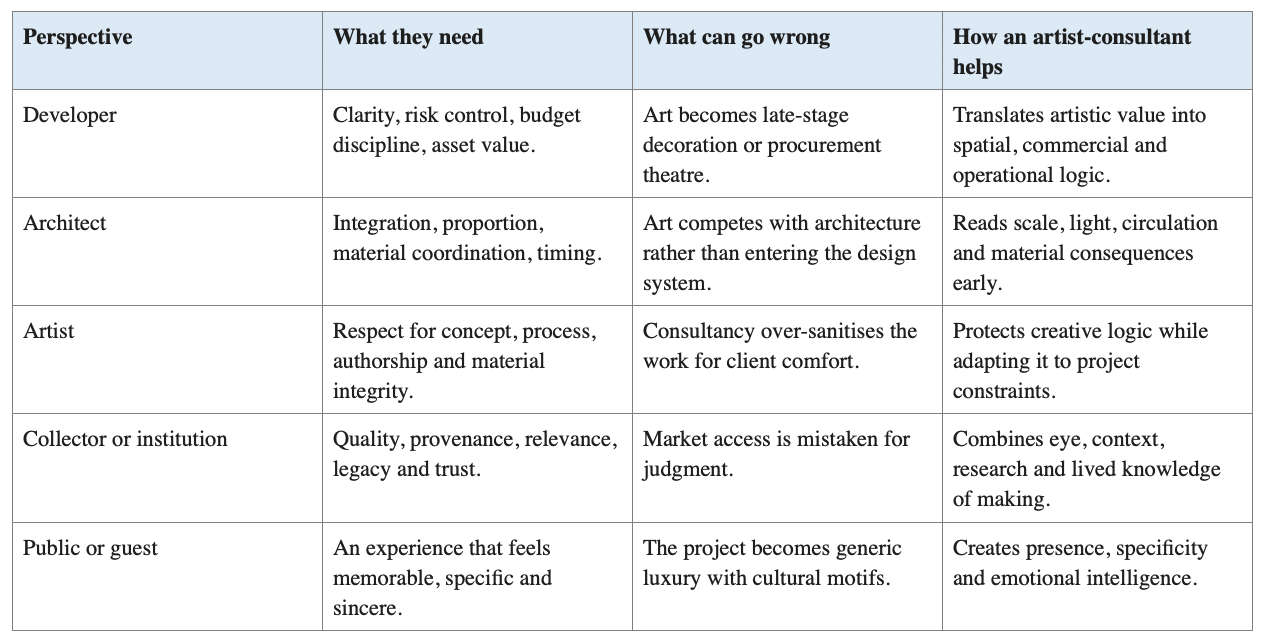
References
[1] Should I hire an art adviser?. Financial Times, 2025. Link
[2] The Art Basel and UBS Global Art Market Report 2026. UBS / Art Basel, 2026. Link
[3] Global art sales grew 4% in 2025 but remain below pre-pandemic levels. The Art Newspaper, 12 March 2026. Link
[4] The problem with art advisers. The Art Newspaper, 1 May 2007. Link
[5] The Institutions and Collectives Putting the Gulf First. Frieze, 2026. Link
[6] After two decades of groundwork, the Gulf region steps into the spotlight. Art Basel, 2026. Link
[7] Saudi art world questions widespread use of consultancies in shaping culture landscape. The Art Newspaper, 9 December 2025. Link
[8] Inside the Growing Consultant Economy Behind the Gulf’s New Mega Museums. Artnet News, 8 December 2025. Link
[9] About us. Studio Other Spaces. Link
[10] Artist Olafur Eliasson’s First Building Is a Meditation on Light and Environment. Architectural Digest, 2018. Link
[11] Vietnam Veterans Memorial. Maya Lin Studio. Link
[12] Richard Serra, Tilted Arc. Smarthistory. Link
[13] Public Art in Private Development Application Form. City of Palo Alto, 2024. Link
[14] Interim Public Art Guidelines for Developers. City of Parramatta, 2026. Link
Note: The article uses a fact-led, art-market editorial register suitable for publication. It does not reproduce the style of any living writer verbatim.